
Henrico Deed Documents and Their Roles
Henrico's Circuit Court Clerk records instruments that affect land. Deeds, deeds of trust, releases, easements, plats, judgments, and liens all pass through the office. Each type does different work. A deed records a transfer. A deed of trust secures a loan. A release shows that an earlier security interest was cleared. The statewide SRA instructions do not publish the exact document-type list, so confirm a filing's label through the clerk's index or the Record Room.
| Deed Type | What It Does | Common Use |
|---|---|---|
| Deed of conveyance | Names the transferor, recipient, and land description | Ordinary ownership change |
| Deed of trust | Records a security interest tied to a loan | Mortgage or later assignment |
| Release deed | Shows a recorded release or satisfaction | Following a loan or lien |
| Executor or administrator deed | Transfers property under estate authority | Probate or estate sale |
| Commissioner's deed | Follows a court-directed sale | Partition or creditor proceeding |
A record title tells you what was filed, not why. A deed of distribution moves land to heirs. A deed of gift may state nominal or no consideration. A court commissioner can convey land under a court order. Read the instrument itself. Also read any case file that authorized it.
Henrico SRA Index Access
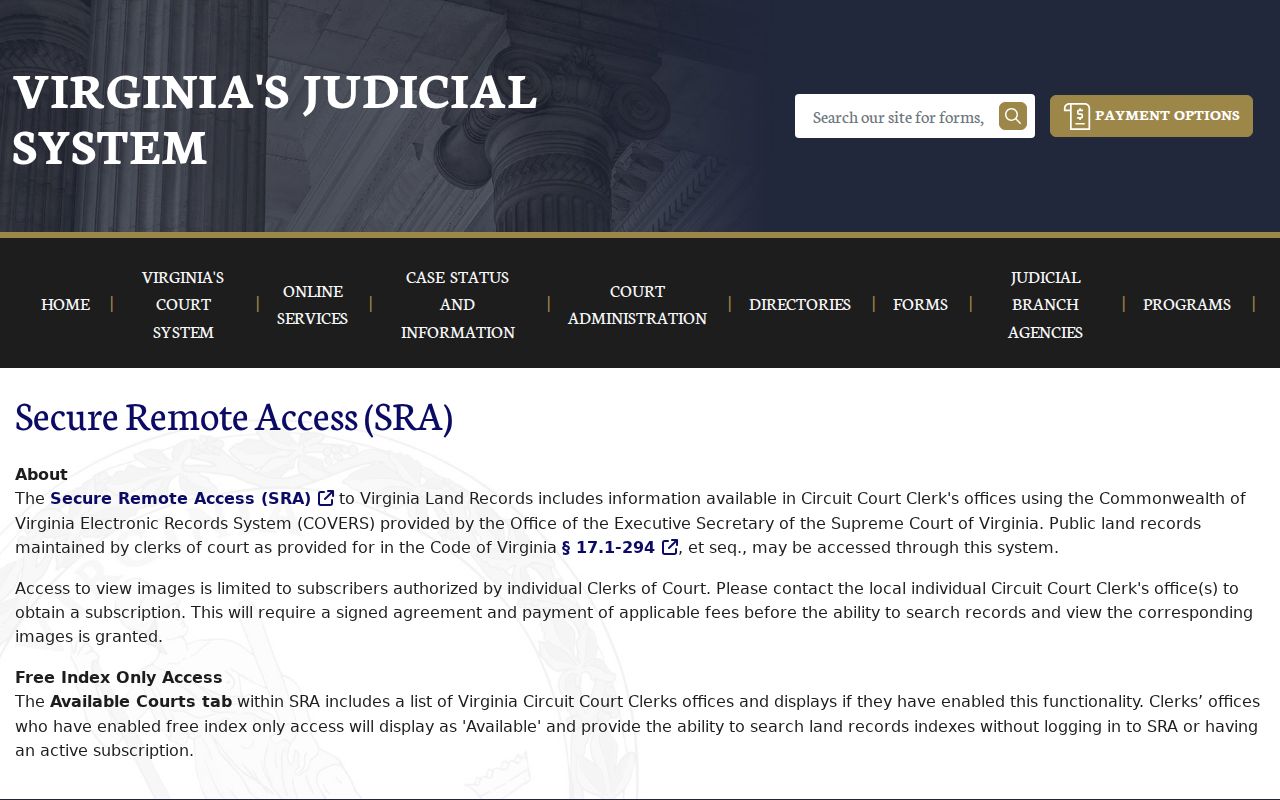
Virginia Courts Secure Remote Access gives online entry to land records. Those records are kept by circuit clerks through the COVERS system. Where a clerk enables it, index-only access is free. Images go only to subscribers the local clerk authorizes. A signed agreement and applicable fees apply. That split matters. The index can identify a filing without handing over the deed image. Henrico's earliest online index year, image cutover, search fields, document filters, and result cap are not published in a static official source. So do not assume the modern index reaches the oldest deed book. When an image is unavailable online, the Circuit Clerk's Record Room at the courthouse is the fallback. Staff can explain access procedures. They will not research a title chain or give legal advice by phone. The Virginia SRA information page explains the difference between index access and subscription image access.
Treat an online result as a lead. When a transfer detail matters, confirm the document with its image or a clerk copy.
Henrico's 1774-1782 Records Gap
The Library of Virginia catalog holds a Henrico record group titled "Records [Deeds, Wills, Etc.], 1774-1782," described as proceedings of commissioners respecting records destroyed by the British. That loss is a local reason to expect gaps in early chains. Not every deed from those years vanished. Still, an incomplete index is not the end of the ownership story.
For a chain reaching this period, check adjacent deed books, grantor and grantee indexes, court orders, wills, plats, and chancery material. The legal description can link an older record to a modern parcel when street names or numbers have changed. Record loss makes cross-checking more important, not less.
Henrico Grantor and Grantee Trail
A grantor conveys an interest; a grantee receives it. To follow Henrico's deed chain, search each prior grantor as a grantee. Look for that entry in an earlier period. Begin with the latest deed reference from the parcel card or the current grantee name. Read the instrument, take the grantor, and search backward again. The index runs on names. Spelling, initials, married names, trustees, estates, and entity punctuation can all change a result.
- Find the most recent recorded deed and note its grantee, grantor, book/page, and recording date.
- Search the grantor as a grantee in the earlier period and open the deed by that owner.
- Repeat with each prior grantor; compare the land description, acreage, road, and adjoining owners.
- When SRA stops, continue with the clerk's books or Library of Virginia microfilm rather than guessing at the cutoff.
- Grantor
- The person or entity conveying the interest.
- Grantee
- The person or entity receiving the interest.
- Chain of title
- The sequence of recorded transfers for one parcel.
- Book and page
- A volume and page reference to a recorded instrument.
Older searches may not carry a modern GPIN. Use subdivision names, acreage, streams, roads, and adjacent owners to test whether two descriptions describe one tract. Note each book and page, so an ambiguous name cannot drag the chain onto a different property.
Henrico Releases and Deeds of Trust
A deed search should cover more than conveyances. Henrico land records also hold deeds of trust, assignments, modifications, releases, judgments, mechanic's liens, easements, covenants, and boundary-related instruments. A deed of trust can linger in the record after a loan changes hands. Search for an assignment and then a release or satisfaction. A lien may be recorded against an owner without a useful parcel label on the assessment card. Compare the instrument's legal description to be sure.
Library of Virginia lists Release Deed Books 1 through 13 covering 1884-1899. These books can reveal the release side of older debt history. That history never looked like a sale. Follow the recorded reference. Check that the release matches the original deed of trust or lien by parties and by book and page. If a filing was enforced in court, the Circuit Court civil record may hold an order or disposition.
Henrico Deed Books Through 1907
The Library of Virginia's inventory reaches remarkably far back. It places Henrico deeds and wills as early as 1677. Deed books themselves begin in 1781. Grantor and grantee indexes cover two stretches, 1781 to 1876 and 1876 to 1907. Plat indexes run from 1805 to 1975. Deed books extend through 1900 and 1901. Those spans describe the archival holdings, not the cutoff of any modern online index.
Working with these older records takes a few tools. The microfilm page is a starting point. It offers book and reel references. Offline channels fill the rest of the picture. The clerk's Record Room, the Library of Virginia, the Henrico History Archives, and county library resources all support research into these materials. A productive method starts with the most recent deed description you hold. Find the prior owner in the name index. Then compare the older instrument's boundaries and adjoining tracts against it.
Each date span matters because these are separate indexes rather than one continuous search. A grantor from 1880 may sit in the later index volume. A plat from that same era belongs in the plat index instead. Once a book and page turn up, read the land description closely. Compare it with the parcel's current section, block, and lot. Keep in mind that older neighborhood names and adjoining-owner descriptions rarely match today's assessment labels. The Henrico microfilm catalog documents the deed books, indexes, and plat runs in detail.
Henrico Property Title Alerts
The Circuit Clerk offers a helpful free service for homeowners. After registering a home or real estate, an owner gets an email notification. It arrives whenever a document tied to the property is filed. An alert simply prompts the owner to look at the new filing. It stops nothing by itself.
The county is clear about the limits. The alert does not block a fraudulent document. It does not judge whether a filing is valid. It also does not substitute for title insurance and a title search. Henrico's land-record guidance also notes the county does not sell property addresses to outside deed-copy solicitations. The deed image and the clerk's index remain the actual record evidence. The alert serves as a practical notice channel. A suspicious filing calls for inspecting the instrument and contacting the right professional or law-enforcement office.
Getting a Henrico Deed Copy
The Record Room sits in the Courthouse Building, Room 240, at 4309 E. Parham Road. Public hours run Monday through Friday, 8 a.m. to 4 p.m. Land-record recording hours end at 3:30 p.m. Copies of land records cost $0.50 per page. Recording fees vary by instrument. A subdivision plat runs $28 per page. Cards are accepted with a 2 percent convenience fee.
Start with the SRA index if it returns the document you need. Follow its local image rules from there. Otherwise, use the clerk's Record Room and its request process. The official FAQ covers public computers and same-day recording. Anything placed at the counter by 3:30 p.m. is recorded that same day. The clerk requires properly signed and notarized originals. You also need a land-record cover sheet. Put the parcel tax-map or PIN on the first page. A self-addressed stamped envelope is needed when a recorded original must be mailed back.
Recorded, not guaranteed. Henrico deed records show filed instruments, not every unrecorded claim or legal issue. An index result is not a title opinion; obtain a full title review when clear ownership is material.
Curious about earlier hands? The former-owner record trail uses the same grantor and grantee method to push a parcel further back through time.